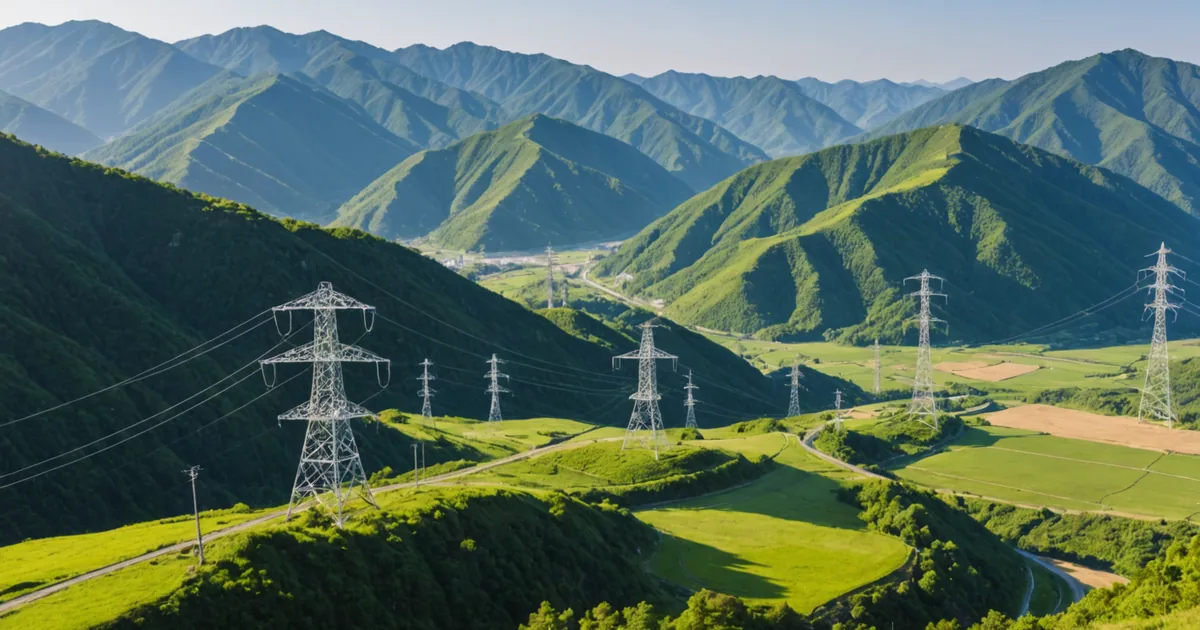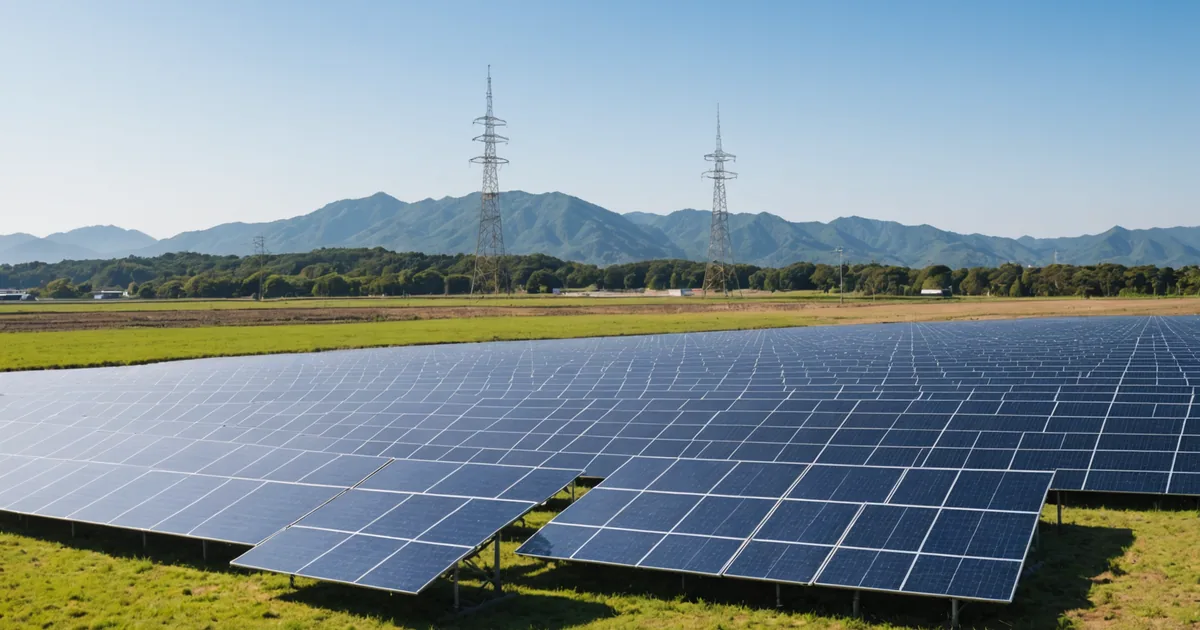

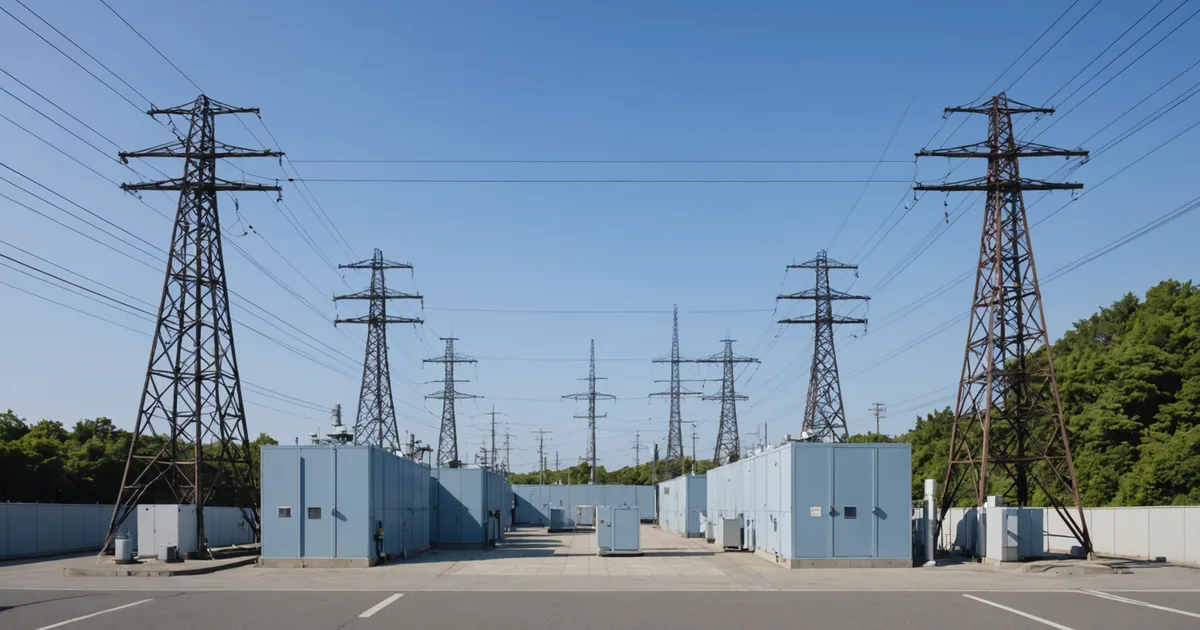
Japan's grid is split at the 60Hz/50Hz boundary, with eastern Japan (Tokyo and northward) running at 50Hz and western Japan (Nagoya and westward, including Kyushu) at 60Hz. The boundary is narrow and the interconnection between the two systems is limited by back-to-back frequency converters with capacity well below what either system's peak generation or demand requires. This is a known structural fact, not a new discovery. What matters for BESS dispatch is that the two halves of Japan cannot freely share renewable surplus or respond collectively to frequency events.
But frequency band is only one layer of the dispatch challenge. The 50Hz eastern system creates a specific set of operating conditions that shape how a battery's frequency response and dispatch optimization must work.
Frequency Regulation and the 50Hz Band
Japan's frequency control standards differ between eastern and western systems. OCCTO (Organization for Cross-regional Coordination of Transmission Operators) oversees system-wide reliability targets, but each area TSO implements them within its own frequency band and response time requirements.
In a 50Hz system, primary frequency regulation (governor free response) requires power plants and storage assets to respond within seconds to deviations from nominal frequency. The frequency deviation thresholds that trigger regulatory response differ from 60Hz practice. This matters for battery inverter control parameters, particularly the dead band width and droop setting around nominal frequency.
A BESS originally configured for 60Hz operation in Kyushu and then deployed in a 50Hz area in Tohoku will not function correctly without inverter parameter reconfiguration. This is not a theoretical problem. As Japan's battery procurement market has expanded, assets designed to one frequency standard have moved between service territories, creating commissioning issues that were not visible during procurement.
Renewable Variability in Eastern Japan's 50Hz Grid
The Tohoku region has seen rapid expansion of wind and solar, particularly offshore wind projects in Miyagi, Akita, and Iwate prefectures. Offshore wind at scale introduces large, fast ramp events that the 50Hz eastern grid must absorb. Unlike thermal-heavy systems with high rotating inertia, a renewable-heavy grid has lower natural inertia, meaning frequency deviations from generation-demand imbalances are larger and faster per unit of imbalance.
A BESS participating in frequency regulation in this context needs an inverter response fast enough to contribute usefully in the one to ten second window before secondary regulation (Load Frequency Control / LFC) responds. Battery inverters can respond in well under one second if configured for primary frequency response mode. The question is whether the dispatch optimization logic gives them the correct headroom to do so without depleting SOC through repeated fast-response discharges.
This is one place where 50Hz eastern grid operation differs practically from 60Hz western grid operation: the frequency excursion patterns from wind variability in the east tend to have different time-frequency characteristics than the solar-dominated variability in western Japan. Dispatch logic tuned purely on Kyushu solar data will not necessarily generalize without re-parameterization.
The Interconnection Constraint and Its Dispatch Implications
The Sakuma and Shin-Shinano frequency converters (the primary 60Hz/50Hz links) have total transfer capacity that is limited relative to each system's renewable generation base. When western Japan has a surplus from Kyushu solar generation and eastern Japan has a deficit from low wind, the converters cannot fully equilibrate the two imbalances. Each system must resolve its own balance.
This means a battery in eastern Japan cannot "rely on" western Japan absorbing its grid's surplus. The eastern system must clear its own frequency deviations with its own resources, including batteries, pumped hydro (limited in Kanto), and gas peakers. The scarcity of balancing resources in the 50Hz east is different from the 60Hz west, and that scarcity shapes the economics and dispatch priority of BESS assets in the two regions.
In practice, BESS assets in the eastern system tend to be called on more frequently for frequency regulation services precisely because the alternative balancing resources are fewer. A dispatch strategy that treats frequency regulation participation as optional or secondary to price arbitrage may leave significant capacity payment revenue on the table in Tohoku.
Dispatch Logic That Accounts for Both Requirements
The practical consequence for dispatch optimization is that SOC management in the 50Hz eastern system must hold a buffer for frequency regulation response that is not optional. If frequency response obligations are contracted and the battery is dispatched down to 10% SOC chasing a JEPX price spike, it cannot provide the contracted regulation response when the next wind ramp occurs. OCCTO's system requirements and the area TSO's ancillary service contract terms both constrain this: contracted primary frequency response capability must be available when called.
We are not saying that price arbitrage and frequency regulation are incompatible objectives. They can be run in parallel if the SOC management logic correctly partitions the battery capacity. A portion of usable capacity is dedicated to regulation (held in a mid-SOC band for bidirectional response); the remainder is available for arbitrage dispatch. The challenge is sizing that partition correctly for a given site's contracted obligations, and then enforcing it through the dispatch optimizer rather than treating it as a soft guideline.
What makes this harder in the 50Hz context is that frequency excursion events driven by wind variability in Tohoku can be larger and faster than the solar-dominated ramps in Kyushu. A regulation buffer sized for a 60Hz solar-heavy grid may not be adequate for a 50Hz wind-heavy grid. That calibration is site-specific, and it is one of the parameters we track per deployment.
What Changes at the Dispatch Layer
The short version: a BESS in the 50Hz eastern Japan grid needs dispatch logic that explicitly models frequency regulation reserve requirements, accounts for the higher wind-driven variability profile of the region, and does not treat the 60Hz/50Hz boundary as a merely administrative distinction. The physics are different. The constraint set is different. And if you are forecasting renewable output for dispatch purposes, the weather patterns in Tohoku are different from Kyushu, which means the forecast inputs need local calibration too.
That local calibration is not a luxury. It is the difference between a dispatch optimizer that runs adequately and one that is actually configured for the grid it is sitting inside.